Which form of folate should you take in pregnancy?
Folate vs. Folic Acid vs. Methylfolate in Pregnancy
… and the question of the infamous MTHFR gene mutations.
We are talking about the wrong things when we fight over methylfolate versus folic acid. I have seen some very passionate posts lately on all sides of the equation.
On one side, people are claiming methylfolate is “dangerous” because it has not been directly studied to prevent neural tube defects. But not being studied for a specific outcome does not automatically make something dangerous, nor does it prove that it cannot produce that outcome. It simply means the study has not been done.
The historical context is also worth noting. Most of the landmark folic acid and neural tube defect studies were conducted between 1980 and 1999. At that time, methylfolate was known biologically, but a stable, standardized methylfolate ingredient suitable for widespread supplement use was not yet readily available. Calcium L-5-MTHF entered the FDA’s new dietary ingredient process around 2000–2001, after most of the major folic acid studies had already been completed.
On the other side, presenting methylfolate as “better” is not accurate either. Better in what way? We cannot say it is better at preventing neural tube defects at this time. Folic acid clearly wins when it comes to the direct evidence in this category.
Methylfolate has advantages in other areas, and it has been studied both during and outside of pregnancy. But it simply has not been studied for this specific outcome. The pregnancy studies to date did not report neural tube defects, which is worth noting, but they were not designed to evaluate whether methylfolate prevents neural tube defects.
I am also seeing people demonize folic acid because it is synthetic and can produce unmetabolized folic acid. It IS true that folic acid can produce unmetabolized folic acid; methylfolate does not. But demonizing folic acid is not accurate either. The actual impact of unmetabolized folic acid is still being hashed out. Right now, the data are mixed. Some studies show correlations with potentially harmful outcomes, while others do not.
People like to choose a “side.” But why?
Why can’t we adopt one of the core principles of science: curiosity?
Curiosity to actually look at the current evidence base. To understand the mechanisms. To do more research for the half of the population that has been left out of research for far too long.
I hope this article helps you see all sides of the Rubik’s Cube together. Let’s be honest about what has and has not been studied. Then let’s talk about it without preaching, shaming, or patriarchal scolding.
First, let’s define the terms
Folate - the umbrella term for the different forms of vitamin B9
Naturally occurring sources of folate: asparagus, spinach, kale, lentils, black beans, avocado, broccoli, oranges
Folic Acid - a synthetic, highly stable form used in fortified foods and many supplements
Methylfolate (5-MTHF) - the active form of folate and main form found in circulation
We care about vitamin B9 in pregnancy because it is essential in the process of preventing neural tube defects (NTDs) in baby.
What happens to each form in the body?
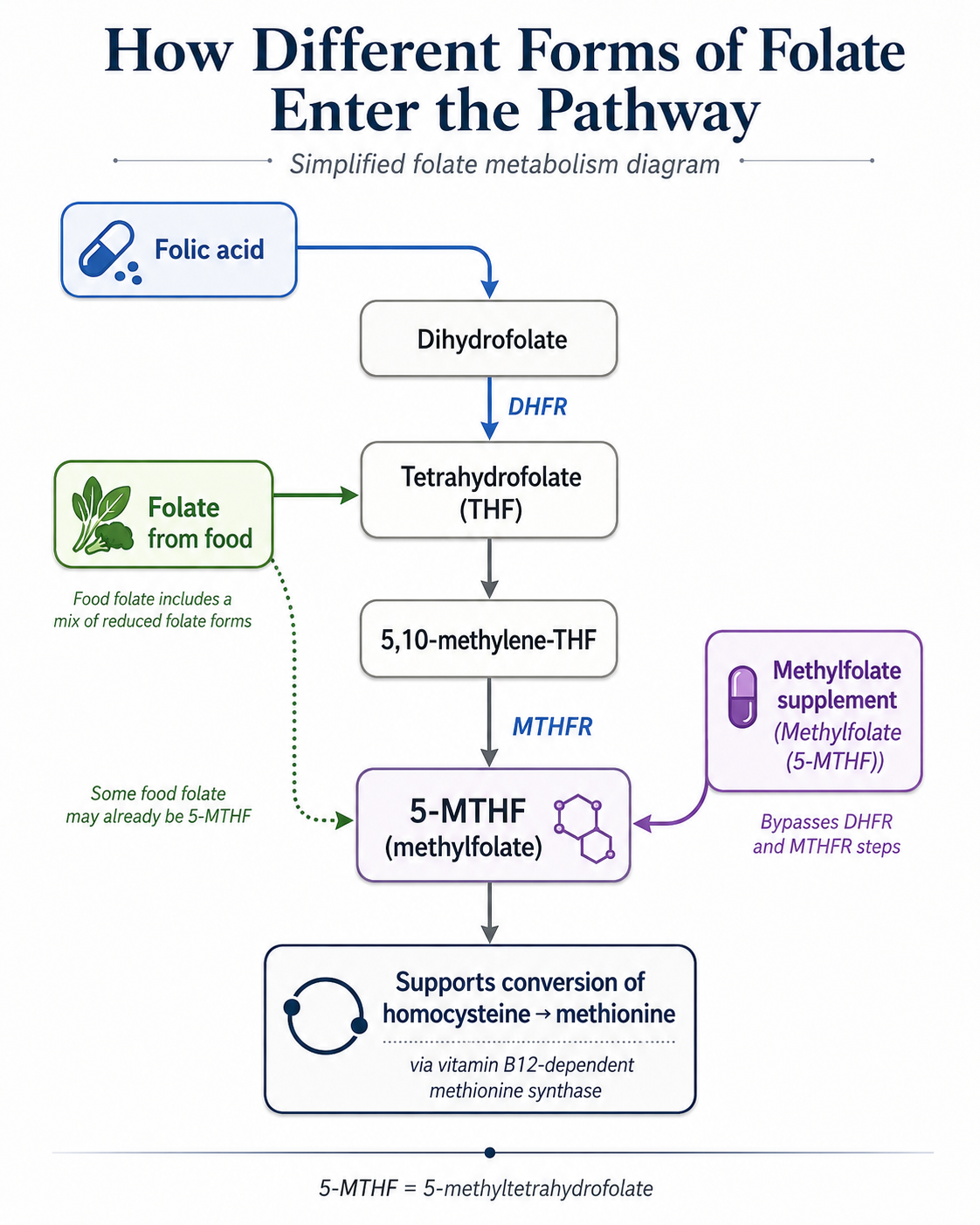
Where does MTHFR come in?
The MTHFR enzyme catalyzes the final step to convert both folate (from food) or folic acid (synthetic supplemnt) into it’s active form, methylfolate. This form is what is used by the body.
Having an MTHFR gene variant can make this enzyme less efficient (to varying degrees - see below). It does not mean this enzyme stops working all together.
In the US:
~40% of the population has a heterozygous mutation (only 1 copy mutated): the enzyme works at about 65% efficiency
~10% of the population has a homozygous mutation (both copies mutated): the enzyme works at about 30% efficiency
[1,2]
Which version of folate prevents neural tube defects?
Folic acid is the only form of folate directly studied in clinical trials specifically related to preventing neural tube defects.
Methylfolate has been studied in pregnancy for other outcomes (see below). But to date, there have been no studies done to specifically look at outcomes related to neural tube defects. This is why current public-health recommendations specify folic acid.
Here are the studies:
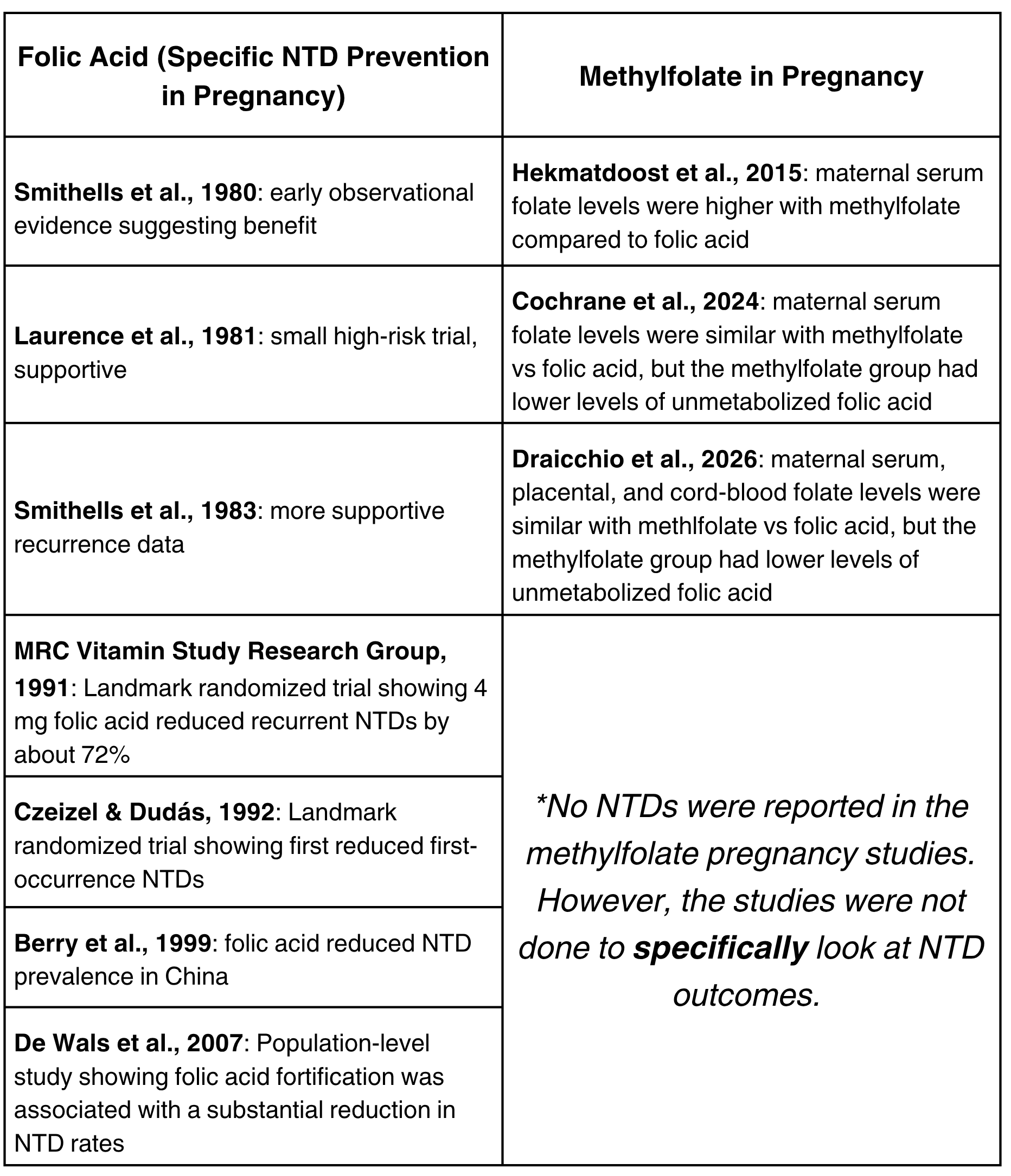
NTDs = neural tube defects
[3-12]
Why is methylfolate appealing?
Studies prove it is indeed absorbed, raises serum folate levels, and reaches placental tissue and fetal cord blood
It bypasses MTHFR conversion and is ultimately the active form of folate that folic acid eventually gets converted to
It lowers homocysteine
It does not produce unmetabolized folic acid (see next section)
However:
We do not have studies directly testing whether it prevents neural tube defects (even though the data makes this biologically plausible).
Is unmetabolized folic acid (UMFA) toxic?
UMFA is unique to folic acid supplementation. The effects of UMFA in the body remain an important unanswered research question.
So far, findings are inconsistent and largely observational.
Some studies have linked higher UMFA with reduced immune system activity and certain childhood neurodevelopmental or allergic outcomes. Other studies examining the same types of outcomes found no association.
So the answer is: we don’t know yet.
[13-17]
What about elevated homocysteine?
When MTHFR activity is reduced (more so with homozygous mutations), homocysteine can rise.
Elevated homocysteine is associated with:
oxidative stress
inflammation
endothelial dysfunction and vascular disease
Methylfolate by passes MTHFR conversion.
However, folic acidalso lowers homocysteine in those with MTHFR gene mutations.
Remember: MTHFR activity does not mean the enzyme stops working all together.
Other important factors that are involved in MTHFR enezymes: other vitamin conversions (B2, B6, B9, B12, choline, betaine), smoking, kidney disease, thyroid disease, medications.
Bottom line: When it comes to MTHFR gene mutations and homocysteiene, folic acid vs methylfolate is not the worry.
[18-21]
To recap
Methylfolate is the more direct form because it enters the body ready to go (bypassing MTHFR conversion).
However, folic acid is the only form that has been directly studied and proven to prevent neural tube defects.
This does not mean methylfolate does not prevent NTDs. It means that specific clinical study has not been done.
Only folic acid can produce unmetabolized folic acid (UMFA). Methylfolate does not produce UMFA. Whether UMFA causes harm at recommended doses remains unclear.
Both folic acid and methylfolate can lower homocysteine, including in people with common MTHFR variants.
And while MTHFR variants are often overblown online, they are not irrelevant. They can affect folate and homocysteine metabolism and matter within the broader context of pregnancy and women’s health.
The bottom line?
While methylfolate likely also prevents NTDs, folic acid is the only form of folate that has been proven to do so.
When it comes to an unborn child’s health, I think everyone can agree the best approach is to use proven, not plausible, data.
Outside of pregnancy: I prefer methylfolate.
In pregnancy: It may be reasonable to take both… but make sure you definitely have the proven form (of course after a discussion with your personal care team).
More importantly: Understanding MTHFR status matters far more than the folic acid vs mehtylfolate conversation. We are increasingly seeing MTHFR variants linked to pregnancy complications like preeclampsia, which is a vascular injury event.
So focusing on optimizing whole-body health, ensuring broader nutrient adequacy, and reducing risk in other ways is really what we should be talking about.
Let’s be more curious, not more divisive. Women’s health deserves more exploration and research.
Citations
1. MTHFR Allele and Genotype Frequencies | CDC. May 28, 2019. Accessed July 23, 2026. https://archive.cdc.gov/www_cdc_gov/genomics/population/genvar/frequencies/mthfr.htm
2. Frosst P, Blom HJ, Milos R, et al. A candidate genetic risk factor for vascular disease: a common mutation in methylenetetrahydrofolate reductase. Nat Genet. 1995;10(1):111-113. doi:10.1038/ng0595-111
3. Smithells RW, Sheppard S, Schorah CJ, et al. Possible prevention of neural-tube defects by periconceptional vitamin supplementation. Lancet. 1980;1(8164):339-340. doi:10.1016/s0140-6736(80)90886-7
4. Laurence KM, James N, Miller MH, Tennant GB, Campbell H. Double-blind randomised controlled trial of folate treatment before conception to prevent recurrence of neural-tube defects. Br Med J. 1981;282(6275):1509-1511. doi:10.1136/bmj.282.6275.1509
5. Lancet 1991; 338:8760:131-137. https://www.sjsu.edu/faculty/gerstman/hs261/Lancet1991-338-8760-131-137.htm
6. Prevention of neural tube defects: results of the Medical Research Council Vitamin Study. MRC Vitamin Study Research Group. Lancet. 1991;338(8760):131-137.
7. Czeizel AE, Dudás I. Prevention of the first occurrence of neural-tube defects by periconceptional vitamin supplementation. N Engl J Med. 1992;327(26):1832-1835. doi:10.1056/NEJM199212243272602
8. Berry RJ, Li Z, Erickson JD, et al. Prevention of neural-tube defects with folic acid in China. China-U.S. Collaborative Project for Neural Tube Defect Prevention. N Engl J Med. 1999;341(20):1485-1490. doi:10.1056/NEJM199911113412001
9. De Wals P, Tairou F, Van Allen MI, et al. Reduction in neural-tube defects after folic acid fortification in Canada. N Engl J Med. 2007;357(2):135-142. doi:10.1056/NEJMoa067103
10. Hekmatdoost A, Vahid F, Yari Z, et al. Methyltetrahydrofolate vs Folic Acid Supplementation in Idiopathic Recurrent Miscarriage with Respect to Methylenetetrahydrofolate Reductase C677T and A1298C Polymorphisms: A Randomized Controlled Trial. PloS One. 2015;10(12):e0143569. doi:10.1371/journal.pone.0143569
11. Cochrane KM, Elango R, Devlin AM, Mayer C, Hutcheon JA, Karakochuk CD. Supplementation with (6S)-5-methyltetrahydrofolic acid appears as effective as folic acid in maintaining maternal folate status while reducing unmetabolised folic acid in maternal plasma: a randomised trial of pregnant women in Canada. Br J Nutr. 2024;131(1):92-102. doi:10.1017/S0007114523001733
12. Draicchio F, Hausser J, Sharafi M, et al. Using 6S-5-methyltetrahydrofolate instead of folic acid in prenatal multivitamin reduces unmetabolized folic acid concentrations in the mother-fetus dyad: a 24-week randomized controlled trial. Front Nutr. 2026;13:1679067. doi:10.3389/fnut.2026.1679067
13. Troen AM, Mitchell B, Sorensen B, et al. Unmetabolized folic acid in plasma is associated with reduced natural killer cell cytotoxicity among postmenopausal women. J Nutr. 2006;136(1):189-194. doi:10.1093/jn/136.1.189
14. Raghavan R, Selhub J, Paul L, et al. A prospective birth cohort study on cord blood folate subtypes and risk of autism spectrum disorder. Am J Clin Nutr. 2020;112(5):1304-1317. doi:10.1093/ajcn/nqaa208
15. McGowan EC, Hong X, Selhub J, et al. Association Between Folate Metabolites and the Development of Food Allergy in Children. J Allergy Clin Immunol Pract. 2020;8(1):132-140.e5. doi:10.1016/j.jaip.2019.06.017
16. Best KP, Green TJ, Sulistyoningrum DC, et al. Maternal Late-Pregnancy Serum Unmetabolized Folic Acid Concentrations Are Not Associated with Infant Allergic Disease: A Prospective Cohort Study. J Nutr. 2021;151(6):1553-1560. doi:10.1093/jn/nxab040
17. Husebye ESN, Wendel AWK, Gilhus NE, Riedel B, Bjørk MH. Plasma unmetabolized folic acid in pregnancy and risk of autistic traits and language impairment in antiseizure medication-exposed children of women with epilepsy. Am J Clin Nutr. 2022;115(5):1432-1440. doi:10.1093/ajcn/nqab436
18. Crider KS, Zhu JH, Hao L, et al. MTHFR 677C->T genotype is associated with folate and homocysteine concentrations in a large, population-based, double-blind trial of folic acid supplementation. Am J Clin Nutr. 2011;93(6):1365-1372. doi:10.3945/ajcn.110.004671
19. Lamers Y, Prinz-Langenohl R, Moser R, Pietrzik K. Supplementation with [6S]-5-methyltetrahydrofolate or folic acid equally reduces plasma total homocysteine concentrations in healthy women. Am J Clin Nutr. 2004;79(3):473-478. doi:10.1093/ajcn/79.3.473
20. McNulty H, Dowey LRC, Strain JJ, et al. Riboflavin lowers homocysteine in individuals homozygous for the MTHFR 677C->T polymorphism. Circulation. 2006;113(1):74-80. doi:10.1161/CIRCULATIONAHA.105.580332
21. De Bree A, Verschuren WMM, Kromhout D, Kluijtmans LAJ, Blom HJ. Homocysteine determinants and the evidence to what extent homocysteine determines the risk of coronary heart disease. Pharmacol Rev. 2002;54(4):599-618. doi:10.1124/pr.54.4.599